Final Major Project
Booker Skelding
Research - Photographers
Davide Tambuchi - Contemporary Documentary Street Photographer
Davide Tombuchi is inspired by the photography of Stephen Shore, a photographer of the New Topographics school. Tombuchi decided to dedicate a tribute to this great artist with a series of pictures taken in Como with his Kiev 4AM camera equipped with a Jupiter 12 (35mm lens).
Tombuchi dedicates this collection called 'Urban Corners', an article to Stephen Shore. Shore is famous for having participated in the school of the New Topographers, collaborating in the exhibition “New Topographics: Photographs of a Man-Altered Landscape” of 1975 with the masters, Robert Adams, Lewis Baltz, Joe Deal, Bernd and Hilla Becher .
Urban Corners

'Urban Corners' the reason I’ve picked this series of images as part of my research is in relation to the corners. Turning a corner represents moving on from a difficult experience. The doors and windows to be found around corners is like a fresh start, a new journey.
This image reminds me of a feeling that there is no way out, a feeling of being trapped and cornered. I’ve chosen this image not to praise it, but to use it as a reflection of the moods described above.
This image of the lady walking around the corner, represents two things for me; I wonder if she’s been followed because of the way the photograph has been taken as a candid street image.
Secondly the bars and shutters on the windows create a feeling of being trapped inside and not been able to get out.
I do like theComposition of the image and the architectural brickwork making use of the different textures and shapes.


This image makes me wonder whether to explore and find out what’s beyond the closed door. It looks daunting yet I am curious and wonder whether I can walk around the corner (to the right of the door)and what would is there to be found.
The door does not appear to have a handle, letterbox or knocker , so it feels like there is no way through that door.
This image has a lighter, brighter and happier feel to it. It encourages me to turn that corner and to walk in to the café.
The lighting and the warmth in the shop windows are encouraging me to want to enter and seek a welcome.

Davide Tambuchi
A tribute to Gabriele Basilico by Davide Tambuchi
Gabriele Basilico was a great architectural photographer from Milan.
This work is based on the wonderful collection “Portraits of Factories” of Gabriele Basilico. In this collection Basilico has documented a world that no longer exists. The factories are now closed.
Gabriele Basilico was a master of the exploration of the the suburbs of the main Italian and European cities. As a tribute to the master, Tambuchi decided to walk his home city Como searching for tracks and details of a world that no longer exists.

I like this image for the dramatic dynamic range. From the very strongly lit building on the left to the dark shadows on the right hand side building.
The lighting indicates to me that it was taken doing bright midday sunlight. Which produces dramatic shadows.
I like the way that the tree on the left hand side obscures some of the windows, which creates a feeling of mystery.
When I look at this image I wonder why they are so many bars on the windows, could it be a prison or a disused camp?.
I’ve not chosen the image for any particular photography technique. Although I am drawn to black and white documentary photography for its emotional vibe.
Looking through the bars, represent a barrier and is another image that represents a feeling of the inability to move forward.


This Image explains how I have felt in the past of being trapped and locked in. The contrasts, textures and barbed wire in the image replicate the turmoil of my mixed emotions.
My eye is constantly drawn back to the bright leaf, the leaf gives me hope, even though it has fallen.
Fenced in. For my privacy.

Words of inspiration - Albert Einstein
“Let’s not pretend that things will change if we keep doing the same things. A crisis can be a real blessing to any person, to any nation. For all crises bring progress. Creativity is born from anguish. Just like the day is born from the dark night. It’s in crisis that inventive is born, as well as discoveries, and big strategies. He who overcomes crisis, overcomes himself, without getting overcome. Who blames his failure to a crisis neglects his own talent, and is more respectful to problems than to solutions. Incompetence is the true crisis. The greatest inconvenience of people and nations is the laziness with which they attempt to find the solutions to their problems. There’s no challenge without a crisis. Without challenges, life becomes a routine, a slow agony. There’s no merits without crisis. It’s in the crisis where we can show the very best in us. Without a crisis, any wind becomes a tender touch. To speak about a crisis is to promote it. Not to speak about it is to exalt conformism. Let us stop, once and for all, the menacing crisis that represents the tragedy of not being willing to overcome it”. – Albert Einstein
I have highlighted a few words in the passage above, that give me inspiration and ring true in my journey in overcoming barriers.
Divyakshi Gupta - Doors are Stories The photographic Obsession
Contemporary Travelling Photographer
Gupta is a travelling photographer based in Mumbai, she photographs doors all over the world. Through her imagery she displays the different cultures via doors and their design. Her travels and photography connects her with lost pieces of herself. She explains that each door tells a story.
Gupta's images are beautiful to look at and they tell their own stories. The colour and textures are mesmerising. She explains that she guesses if there are mysteries and emotions behind the doors.
Although I love this imagery and I am inspired to make my own, these beautiful doors do not help narrating my story. For my story is not so pretty and majestic, so it would be an injustice to my FMP to try and explain by using other peoples preferred imagery to look at. I need to explain my mysteries and emotions.


As beautiful as these doors are, I feel sombre and homesick when I look at them. The unknown makes me feel uneasy.
I love the arch framing on the image above
Duane Michals
Historic American Journalist Photographer
Born 18 February 1932 in McKeesport, Pennsylvania.
A large portion of Michals’ work is portraiture which attempts to illustrate the thoughts and emotions of the subject. Famously he has photographed Andy Warhol, Warren Beatty and Jeanne Moreau among many others.
Another area of endeavour has been to catalogue deserted sites in New York City. His photos often contain hand written notes in the margins.
The link below takes you to the artworks compiled by artnet for Duane Michals

Michals creates narratives within a series of images. Blending images with text in a format similar to cinematic sequences, his hallmark process is evinced in a group of 9 photographs titled Things are Queer (1972). “I use photography to help me explain my experience to myself,” he reflected. “I believe in the imagination. What I cannot see is infinitely more important than what I can see.
I particularly like this series of six images, represented with a slightly different reflection in the mirror. I am drawn to the final image, where the reflection has no face. This delivers a powerful message and reminds me of how I felt for a long time after being stripped of my privacy. I felt I had no identity or reason.

Sir Don McCullin - Documentary, Reportage, Journalist Photographer
I have chosen to research Sir Don McCullin for his use of documentary photography and how he uses photo essays to narrate and report.
McCullin's work commenced in 1959 is almost exclusively concerned with the darker side of humanity, focussing on poverty and war over a period of more than 50 years.
-
He has said that he does not trust digital photography: it can be manipulated, it cannot be believed;
-
He said that photography is not Art! The idea that photography is art began in America;
-
The only major conflict he did NOT cover was the war in the Falklands. This was because he was not granted a permit to travel there by HM Govt. Presumably Mrs Thatcher thought his work in Vietnam was too damaging to the US cause and hence did not want him to spoil her own propaganda.
-
He says he feels ashamed for making a success of his career by using the misfortune of his subjects. This refers to wars and poverty/starvation.
Sir Don McCullin is often cited as Britain’s greatest living photographer. Born in 1935 in London’s East End, he documented the lives of the homeless impoverished people of that area from the late 1950s through the 1960s. He is renowned as a “war photographer”, a title he is not comfortable with; pointing to his work in the industrial cities of the United Kingdom and the African AIDS epidemic. Nevertheless, his documentation of wars around the world provides outstanding examples of his work. His 18 year period as international correspondent for the Sunday Times Magazine yielded unforgettable images of war and conflict in Biafra, Vietnam and Northern Ireland. More recently he has concentrated on still life and landscape photography. He was awarded a knighthood in the New Year’s Day Honours 2017.


This image has a voyeuristic feel to it, the low positioning of the camera and the subjects unaware of the image being taken.
The dynamic range of the blacks and whites create a powerful contrast.


This image of the soldier thoughtfully looking through the window, makes me wonder what he’s thinking about and what is he looking at.
I love the bleached lighting coming through the window contrasting against the deep, rich blacks of the soldiers uniform. I see the outline of his gun and the portrait underneath the window. I wonder what has happened to them if they’re alive or dead. Was he protecting them?, or did he have a part in destroying their home and lives?.
A sorrow image, documenting the hell of war.
This image shows the front of a building ruined by an explosion. The men stood in the open doorways and windows, I wonder why they are so well dressed in suits?. The image looks staged, which McCullin does admit, that some of his images are staged. I prefer to capture images in a candid, reportage style. Although that takes away nothing from the fact that I am inspired by McCullin's photo essays.

Martin Parr - Social Documentary Photographer
Martin Parr was born 23 May 1952 in Epsom, Surrey, England. He, like me, caught the photographers’ bug from his grandfather, George Parr, an amateur photographer.
Parr claims that, “... you have to be obsessive to find your passion and make photography work.” That is a statement that I agree with. One cannot be casual about such a pursuit as photography. He also says that he was influenced by copies of Creative Camera magazine.
Martin Parr studied at Manchester Polytechnic and is today known for his use of imagery in an innovative way, his approach too social documentary.
Parr’s most famous series of photographs is “Last Resort”, a social record of the resort town of New Brighton on the Wirral Peninsula, near Liverpool. The series was produced between 1983 and 1985 before the sad and abrupt decline of New Brighton as a desirable holiday resort. The sands disappeared, the ferry closed down and the pier was demolished. Despite the remaining swimming lido and promenade, the resort is a shadow of its earlier self.
The set of photographs is an invaluable record of a town and culture that is no longer with us.
He become interested in filmmaking (making a film of the boy band Pet Shop Boys) and in fashion and advertising. A large retrospective of Parr’s work was held in 2002 at the Barbican Art Gallery and the National Museum.
In 2014 Martin produced Black Country Stories: a social documentary in images of the cultural, social history of this Midlands of England area. His photographs cover pubs and clubs, dog training classes, stunner fetes, factories and foundries, tea dances and much more.
The reason I refer to Parr in my research towards this project is because of his candid style of documentary photography and how his subjects are unaware that he has captured them in his images. Most of his images in the collection 'Last Resort' are not flattering to the individual and on occasion he is exploiting them. For this reason I dislike most of his work, I understand he is documenting society, but at the expense of belittling his subjects. I feel emotional about this because of the images and footage taken of me without my knowledge or authority, which exploited, violated, and left me in social fear.
Ive chosen this image, to hi-light the voyeristic style, Parr has taken the image, without the consent of the parents, he has photographed a young baby. I do not believe this image is aimed to exploit or belittle as most of his images do.

'Exposed' was an exhibition held at the Tate Modern in 2010. aestheticamagazine.com/voyeurism-surveillance-and-the-camera/
Aesthetica Magazine journalist Niamh Coghlan, reported that the exhibition, 'Exposed', tackled taboo subject, questioning the ambiguity of surveillance and voyeurism. The prolific use of mobile phones, cameras, CCTV, and the internet has ensured that we are never alone or unwatched. The exhibition identified.. the close relationship between candid street photography and voyeurism.
Coghlan stated;
New technology has enabled us to become amateur artists and removed the cloak of innocence that used to shroud candid, amateur shots. Dramatic as it may sound, we increasingly live in a Big Brother society where every move is watched and charted, in, for the most part, the interest of “safety”. We are members of a post-9/11 society that is increasingly content to allow a higher degree of surveillance and intrusion into our private lives as this intrusion supposedly offers more protection. The inherently invasive quality of the photograph is discussed by critics, typically from a more theoretical standpoint than an actual examination of the historical use of photography as a tool of investigation and documentation.
Paul Sanders is a landscape photographer and he uses his photography as therapy. He also classes himself as a therapeutic photographer. This is something that I am really interested in.
I’ve connected with the similar feelings of depression that he suffers from and how photography has saved him. He holds photography workshops specifically aimed as therapeutic remedies in coping with depression. I am inspired by his work and ethos.
My project started off being architectural which developed into a narrative through doors and windows.
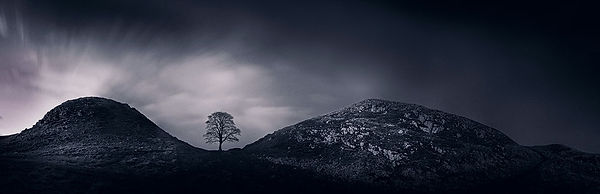
Sanders pictures show his moods and feelings. In this image, he described that the tree in isolation is sometimes the way that he feels when in a dark, lonely place.
The strong vignette on the photograph deepens the shadows and the image narrates a mood of a depression.
When I look at this image, the tree in isolation reflects feeling alone, the minimalistic look reflects innocence. It appears that something is holding the tree up. A sign that it needs support, as we do as individuals from time to time.

Paul reckons the emptiness of this image, taken in Şirnea, Romania, echoes the loneliness he was feeling. ‘I liked the fact the tree has support and the fence gives it direction, too grow'.
Paul Sanders
Jon Pountney - Documentary Photographer

Jon Pountney was at Paul Cabuts 'Chapel' exhibition. He gave a presentation on the 'SouthWalesProject', he explained that it was a plan to replicate a modern version of 'TheValleysArchive'. I was very keen to learn about the proposal and immediately gave my details to be involved.


Considering I had not met Jon Pountney before I took these images, is remarkable how my sub-conscious mind made these images.

Jon Pountney and his team; Anna Jones, Shaun and Dan, talked of their ares of expertise and what they would be most suited to in the southwalesproject . The project is open to who wants to submit work for consideration.